


How to Train a Reactive Dog: A Calm, Kind, Step-by-Step Plan

If your dog barks, lunges, or spins at the end of the leash the moment another dog, a jogger, or a bike appears, you already know how stressful walks can feel. You might feel embarrassed, judged, or worried that something is wrong with your dog. Please take a breath: none of that means your dog is bad, and it does not mean you have failed.
Reactivity is one of the most common behaviour challenges dog owners face, and there is a kind, proven way through it. Learning how to train a reactive dog is not about forcing your dog to behave. It is about understanding what your dog is feeling, giving them space, and gently teaching them that the world is safer than it seems.
This guide walks you through what reactivity really is, why it happens, and a calm, force-free plan you can start today. No harsh tools, no blame, no quick-fix gimmicks that make things worse. Just patient, humane steps that help your dog feel safe again.
- Reactivity is an over-the-top emotional reaction to a trigger (other dogs, people, bikes, noises), almost always driven by fear, frustration, or over-arousal. It is not the same as aggression, and it is not your dog being dominant, bad, or stubborn.
- The barking and lunging are communication. Your dog is usually saying 'I need more space,' not trying to be defiant. Punishing it strengthens the fear and can make reactivity worse.
- The single most useful idea is your dog's threshold: the distance at which they notice a trigger but can still stay calm and take a treat. All good training happens under threshold.
- The evidence-based method is force-free: manage the environment, work under threshold, and use desensitisation plus counter-conditioning (pairing the trigger with high-value food) so the trigger comes to predict good things.
- Aversive tools like prong, choke, and shock collars, leash jerks, and 'alpha rolls' backfire. They suppress warning signs, increase fear, and can trigger a bite.
- See your vet first to rule out pain, then work with a qualified, force-free trainer or a certified behaviourist. Progress takes weeks to months and is not linear.
What 'Reactive' Really Means (And What It Does Not)
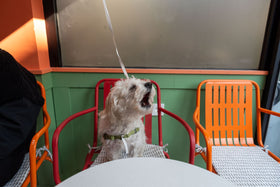
A reactive dog responds to normal, everyday situations with an abnormal, excessive level of arousal. Think of a dog barking hysterically at another dog on the far side of a fence. The reaction is out of proportion to the situation, but it is not the dog being 'bad'.
The most important thing to understand is that reactivity is not the same as aggression. The American Kennel Club describes reactivity as out-of-proportion emotional arousal, while aggression is threatening or harmful behaviour aimed at conflict or distance. A reactive dog's goal is usually just to make the scary thing go further away, not to cause harm.
| What you see | Reactivity (usually fear or frustration) | True aggression |
|---|---|---|
| The goal | Increase distance: 'please back off, I need space' | Intent to threaten, control, or cause harm |
| The emotion underneath | Fear, anxiety, frustration, or over-excitement | A serious conflict the dog feels forced into |
| Typical behaviour | Barking, lunging, spinning, whining, pulling toward or away from the trigger | Sustained threat, and most often a last resort when a dog feels it has no other choice |
| How common it is | Very common, and most reactive dogs are frightened, not dangerous | Less common, and usually needs professional assessment |
| What helps | Distance, calm handling, and force-free desensitisation | A vet check plus a qualified behaviourist, urgently |
Those big, dramatic displays are communication, not defiance. When your dog barks, lunges, spins, or whines, they are usually saying 'I need more space.' This has nothing to do with dominance or your dog trying to be 'alpha'. Dogs that react like this are not being mean or bad; they are frightened, and the behaviour is simply how they ask a perceived threat to move away.
One honest caveat: because a highly aroused brain struggles to think clearly, reactivity can, over many failed repetitions, tip into defensive aggression if it is mishandled. That is exactly why the calm, force-free approach in this guide matters so much. Handled kindly, most reactive dogs simply need help feeling safe.
Why Dogs Become Reactive (And Common Triggers)
Reactivity is driven by emotion, not spite. According to Dogs Trust, the main drivers are fear or anxiety (barking and lunging to increase distance from a perceived threat), frustration (an explosive display when a dog cannot reach something it wants), and over-arousal, where a dog is simply too wound up to focus.
Frustration is often misunderstood. A 'frustrated greeter' may actually love other dogs and become intensely wound up when the leash or a fence stops them from saying hello. Same barking and lunging, very different feeling underneath.
Common triggers include other dogs on or off lead, unfamiliar people and visitors, children, fast-moving things like joggers, cyclists and cars, loud noises such as fireworks and thunder, cats and small animals, and busy, crowded places. The trigger does not have to seem scary to you. It only has to feel scary to your dog.
Before starting any behaviour work, book a vet visit to rule out pain. Dogs Trust is clear that pain and poor health affect how well a dog copes, and without addressing an underlying issue, reactivity is unlikely to improve. Conditions like sore joints can quietly make a dog far less tolerant, so this step comes first.
The One Idea That Changes Everything: Threshold
If you learn only one concept, make it threshold. Your dog's threshold is the distance at which they notice a trigger but can still stay calm, think, and take food from you. Get any closer and they go 'over threshold', react, and can no longer learn.

Here is a plain example. If your dog reacts to other dogs at 20 feet, you do not train at 20 feet. You start at 30 or 40 feet, where they can see the other dog but still eat a treat and look back at you. All the good work happens under threshold.
Threshold also explains why bad days happen. When a dog meets several stressors in a short time, stress hormones like cortisol build up. This 'trigger stacking' means a dog who coped fine yesterday can boil over at something small today, because their stress bucket was already full.
And cortisol takes time to drain. The AKC notes some dogs shake off stress quickly, while others carry it for days. That is the science behind rest days and decompression: your dog physically needs time to come back down before the next challenge.
How to Train a Reactive Dog, Step by Step
Here is the calm, force-free plan. Work through it gently and never rush a stage. This is the heart of how to train a reactive dog without fear or force.

Step 1: Manage the environment. Before you change anything, stop your dog rehearsing the reaction, because every rehearsal makes it more likely. Keep distance from triggers, walk at quiet times on quiet routes, keep the leash loose (a tight leash adds stress), and use barriers like parked cars or hedges to block sightlines. A well-fitted harness and a fixed-length, non-retractable leash give you calm, predictable control.
Step 2: Find the threshold distance. For each trigger, work out how close your dog can be while still staying relaxed and able to eat. That is your starting line. It might be 10 feet for one trigger and 40 for another.
Step 3: Desensitisation plus counter-conditioning. This is the core method. Keep your dog under threshold, and every time the trigger appears, feed a stream of high-value food (small pieces of meat or cheese). Over many sessions, your dog learns that 'other dog appears' predicts 'wonderful things happen', and the trigger stops being scary. The AKC is honest that this can take months, and the longer a dog has felt a certain way, the longer it takes.
Step 4: Teach focus and an escape. Give your dog something to do instead of reacting. 'Watch me' rewards eye contact, while the 'Look at That' game, a well-known force-free technique, rewards your dog for calmly noticing a trigger and then looking back to you. Pair this with a smooth 180-degree U-turn so you can always create distance quickly and kindly.
Step 5: Build up gradually. Only decrease distance or add duration once your dog is genuinely relaxed and looking to you for their treat at the current level. If they react, you have simply asked for too much too soon. Add distance, make it easier, and try again another day.

- Fixed length for steady, predictable control near traffic or other dogs
- Helps you keep a loose leash and add distance calmly, without jerking
- Pairs well with a well-fitted harness for gentle handling
Decompression And Everyday Management
Training sessions are only part of the picture. A reactive dog needs a life that keeps their overall stress low, so their bucket rarely overflows in the first place.
Sniffing is naturally calming and self-soothing. A slow, sniff-led 'decompression walk' where your dog leads with their nose lets them use their brain, burn nervous energy, and settle. On days a busy walk feels risky, a quiet sniffari or garden time can be kinder than pushing on.

Rest matters more than most owners realise. Dogs need a lot of sleep, often around 12 to 16 hours a day, plus a quiet, comfortable place to properly switch off. A calm rest spot away from the front window and foot traffic helps an over-aroused dog actually recover.
Home enrichment helps too. Licking and chewing are self-soothing behaviours, so a lick mat, a food-stuffed toy, or a snuffle mat can help a stressed dog wind down after an outing. Space out challenging walks, build in genuine rest days, and avoid stacking several stressful events into one day.
- Encourages slow, soothing licking that helps an over-aroused dog wind down
- An easy addition to rest days and post-walk recovery time
- Enrichment only: a decompression aid, never a treatment or cure for reactivity
Why Aversive Tools And Punishment Backfire
It is tempting to reach for a quick fix, especially when walks are stressful and people are watching. But punishment and aversive tools make reactivity worse, and the reasons are well established.
When you punish barking or lunging, your dog does not conclude 'I should be calm.' As the AKC explains, they associate the punishment with the trigger, which strengthens the very fear or frustration causing the reaction. You confirm that other dogs really are bad news.
Prong, choke, and shock collars, spray and ultrasonic devices, leash jerks, 'alpha rolls', and shouting all suppress behaviour rather than change how your dog feels. The American Veterinary Society of Animal Behavior recommends reward-based methods only, because aversive approaches are linked to fear, anxiety, stress, and aggression, and a worse relationship with you.
There is a serious safety angle too. Preventive Vet warns that harsh corrections can punish away a dog's early warning signals, like growling, producing a dog that seems to 'bite out of nowhere'. Those warnings are valuable. We never want to silence them.
When (And How) To Get Professional Help
You do not have to do this alone, and for many dogs, expert help is the fastest, kindest route forward. Start with your vet to rule out pain or a medical cause, because discomfort can create or worsen reactivity.

Next, look for a qualified, force-free trainer or a certified behaviourist. Accreditations to look for include CCPDT, IAABC, APDT, ABTC, or a veterinary behaviourist. A good professional will assess your individual dog, identify triggers, and build a step-by-step plan tailored to you both.
For some dogs, vet-prescribed medication is an appropriate part of the plan. It can help settle the underlying emotional state so that training can work, and it is always a veterinary decision made alongside behaviour work. This is never something to attempt yourself, and this guide gives no dosing advice.
Reaching out is not a failure. It is one of the most caring things you can do for a dog who is struggling, and consistent, kind follow-through at home is what makes any plan succeed.
Common Mistakes to Avoid (and What to Do Instead)
-
Avoid: Punishing the barking or lunging
Instead: It is fear or frustration communication, not defiance. Punishment makes your dog link the unpleasantness to the trigger, strengthening the reaction. Add distance and reward calm instead. -
Avoid: Using prong, choke, or shock collars
Instead: These suppress warning signs and can worsen fear and reactivity. Use a well-fitted (ideally front-clip) harness and reward-based training that changes how your dog feels. -
Avoid: Flooding: getting too close to triggers
Instead: Forcing your dog near a trigger backfires. Work under threshold, far enough away that your dog can still eat and stay calm (that might be 10 feet or 40), then pair the trigger with high-value food. -
Avoid: Walking the same busy route and repeatedly boiling over
Instead: Every rehearsal cements reactivity. Switch to quiet times and routes, or drive to a calm spot, so your dog stays under threshold and never practises the reaction. -
Avoid: Tightening or jerking the leash
Instead: A tight, jerked leash adds stress. Keep the leash loose, use a fixed-length leash and a harness, and make a smooth U-turn or cross the street to create distance calmly. -
Avoid: Forcing greetings and socialising
Instead: You cannot force a dog to like other dogs. While you work on reactivity, avoid other dogs rather than pushing face-to-face meetings. Distance is a kindness, not a setback. -
Avoid: Expecting a fast fix
Instead: Desensitisation and counter-conditioning take weeks to months, sometimes longer, and rushing floods your dog and causes setbacks. Go slow, keep sessions short and successful, and celebrate small wins. -
Avoid: Going it alone with a serious case
Instead: See your vet first to rule out pain, then work with a certified, force-free trainer or behaviourist. Expert guidance is safer and usually much faster than struggling solo.
Your Dog Can Feel Safe Again
If you take one thing from this guide, let it be this: your reactive dog is not bad, dominant, or broken. They are a good dog having big feelings, and they are asking for your help in the only way they know how.
Knowing how to train a reactive dog really comes down to kindness with a plan. Give your dog distance, keep them under threshold, pair scary things with wonderful things, and protect their rest so stress can drain away. Skip the harsh tools and quick fixes; they only deepen the fear.
Progress will come in small, uneven steps, and that is completely normal. Some days will feel like a breakthrough and some will feel like a slide backwards. Keep going gently, lean on your vet and a force-free professional when you need to, and trust the process.
You are already doing the hard, loving work by learning a better way. Stay patient, stay kind, and your dog can slowly learn that the world, and the person on the other end of the leash, are safe.
Keep reading
- How to Help a Dog With Separation Anxiety — ease the home-alone stress that often feeds reactivity.
- How a Slow Feeder Mat Calms Mealtimes — a calming enrichment tool for at-home decompression.
- How to Take Care of a Puppy — build calm, confident foundations from day one.
Frequently Asked Questions
Is my reactive dog aggressive?
Usually not. Reactivity and aggression are not the same thing. Reactivity is an over-the-top emotional reaction, most often driven by fear or frustration, and the goal is simply to make a trigger go away. Most reactive dogs are frightened, not dangerous. That said, if you have any concerns about safety, have your dog assessed by your vet and a qualified behaviourist.
Can a reactive dog ever be fully 'cured'?
It is more helpful to think in terms of managing and greatly improving reactivity rather than curing it. With a consistent, force-free plan, many dogs become far calmer and happier, and walks become enjoyable again. Some dogs will always need certain triggers managed with distance, and that is completely fine. Progress, not perfection, is the goal.
How long does it take to train a reactive dog?
Honestly, it takes time. Desensitisation and counter-conditioning typically work over weeks to months, and sometimes longer, especially if your dog has felt this way for a long time. Progress is gradual and not linear, so expect good days and setbacks. Rushing tends to backfire, while slow, steady work under threshold builds lasting change.
Should I let my reactive dog meet other dogs to get used to them?
No, forcing greetings usually makes things worse. You cannot force a dog to like other dogs, and face-to-face meetings while your dog is struggling can flood them and deepen the fear. Instead, work at a comfortable distance where your dog stays calm, and only close the gap gradually as they relax over many successful sessions.
Are prong, choke, or shock collars ever okay for a reactive dog?
No. These tools, along with leash jerks and 'alpha rolls', suppress your dog's behaviour rather than change how they feel, and they are linked to more fear, anxiety, and aggression. They can even punish away the warning growl, leading to a dog that seems to bite without warning. Reward-based, force-free methods are both kinder and more effective.
When should I see a professional about my dog's reactivity?
Sooner rather than later is ideal. Start with your vet to rule out pain or a medical cause, since discomfort can create or worsen reactivity. Then work with a qualified, force-free trainer or certified behaviourist (look for CCPDT, IAABC, APDT, ABTC, or a veterinary behaviourist). For some dogs, vet-prescribed medication is a valid part of the plan, decided by your vet alongside training.

We're a team of dog lovers who believe every dog deserves patience and kindness — reactive dogs most of all. For this guide we cross-checked our advice against American Kennel Club, Dogs Trust, AVSAB and Preventive Vet so the training and welfare guidance you follow is grounded in trusted, force-free sources, not guesswork. None of this replaces your own vet or a qualified trainer, who should always be your first call.